Skip to Content

Listen to the Joystiq Podcast (because your ears can't read)
AOL Tech

patent posts

Apple's 'active packaging' patent application tries to reinvent the box


Electronics packaging has been growing steadily smaller and less annoying over recent times, but here comes Apple adding complexity where we didn't know it was needed. The bright sparks at Cupertino envision powered, data-transmitting boxes that will ensure the device within is fully juiced, packing the latest firmware, and capable of pumping out video demos so that the packaging needn't get in the way of wooing customers. Sure, up-to-date firmware and a full battery sound nice, but we can't help but wonder about the price premium we'd have to swallow to be able to see our new toy dancing before we've even set it free from its box.

[Via Phone Arena]

Apple patent applications offer glimpses of haptic screens, RFID readers, fingerprint ID


Alright, so you know the drill by now. A patent application doesn't necessarily mean an actual product is on the way -- but it's always fun to speculate, right? And this latest trio of applications from Apple certainly provides plenty of speculation fodder. The most notable of the lot is an application for a "multi-touch display screen with localized tactile feedback," which Apple seems to be at least considering as a possibility for the iPhone (or iPod touch). Like some similar systems, Apple's application covers a screen that uses a grid of piezoelectric actuators that can be activated at will to provide vibrational feedback when you touch the screen. Apple even goes so far as to use a virtual click wheel on an iPhone as an example. Other patent applications include a fairly self-explanatory RFID reader embedded in a touch screen, and a fingerprint identification system that could not only be used for security, but to identify individual fingers as an input method -- for instance, letting you use your index finger for play/stop and your middle finger to fast forward.

Sony patents new Cell-based PS2 emulator


At first glance, we thought this all sounded a little too familiar: as you know, some PS3s had software-based PS2 emulation way back in 2007. So it was a little bit of a surprise when Siliconera unearthed patent docs dated last December (and only published by the patent office late last week) for the technology to decode and recompile software written for the PS2's Emotion Engine on the current device's Cell Processor. There's been some speculation that this functionality might be included in the rumored slim PS3 at some point -- either in the form of support for your old school PS2 discs or for digital downloads. Who knows? You might be playing your old copy of Shrek: Super Party! on your PS3 sooner than you think.

[Via Joystiq]

TiVo coming to Time Warner Cable, potentially lots of other providers


It's been a long, messy road, but now that TiVo's beaten a victory out of EchoStar in that seemingly-endless DVR patent lawsuit it sounds like the company is trying to exert some muscle -- it's already in talks to bring its service to Time Warner Cable, and sources have told Bloomberg the ultimate plan is to eventually collect royalties from every pay-TV provider in the US. That might sound bullying and even a little trollish, but keep in mind these patents have withstood pretty much every legal challenge EchoStar could throw at them, so TiVo's operating from a position of some certainty here -- especially since it's got license agreements with huge players like Comcast and DirecTV to use as leverage in negotiations as well. Of course, none of this solves any of TiVo's actual problems with its products, and the company's topsy-turvy balance sheet has some analysts thinking its ripe for a buyout by one of the bigs, so things could change dramatically at any minute, but for right now it sounds like your chances of getting the TiVo interface on your cable or satellite company DVR just went up, and that's almost certainly a good thing.

Rambus drops patent suit against NVIDIA Update: only part of it

So much for all those Rambus / NVIDIA fireworks we know you were hoping for -- the two companies just announced that the patent infringement proceedings begun last year have come to a close and the International Trade Commission has been asked to drop its investigation. According to the statement, "Rambus has conceded that NVIDIA products do not infringe on its four patents before the ITC." That's that -- guess we'll just have to get our kill-crazy destruction kicks elsewhere.

Update: Sigh -- Rambus has told MarketWatch it disagrees with NVIDIA's release, and that it's still litigating five more patents before the ITC. Round and round we go.

DISH / EchoStar DVR injunction temporarily put on hold by court

It's the case that never ends -- the U.S. Court of Appeals for the Federal Circuit has issued a temporary delay of of the injunction and fine handed down yesterday in the EchoStar / TiVo lawsuit while it considers an appeal, meaning that DISH owners with older DVRs won't have to worry about losing their pause-and-rewind functionality at least for now. That pretty much means we're back in stasis with this one, with even more delay to come if the appeal is granted. That's cool, we needed a nap anyway.

Teen invents pen-sized pico projector while your kid's busy beating up honor roll students


Life can sure be confusing for a teenager in this fast-paced techno-world we live in. Without the proper guidance, a kid could find himself unplugging someone's life support, or going to jail for borrowing the neighbor's WiFi. Hell, if old man General Tommy Franks (retired) has his way you won't even be able to hang out behind the Safeway and enjoy a six pack with your fellow juvenile delinquents without being tracked via GPS! So it warms our hearts when we do hear of a youngster that's bucked the odds and done something constructive. For example, a 13-year-old named David Baker has received a patent for his Light Beam Delivery System, a pico projector that fits in a pen casing, and works by combining three RGB lasers with an optics assembly that creates a light ray that is then shined through a rotating disk to the screen. "When the light goes through the lenses," he explains, "they take each light pixel and shine it onto a screen or wall. The lenses run back and forth until it fills the screen. This process repeats 30 times per second to make it appear as though you're looking at a solid image and not a series of pixels, and you have the image projected." And where did he find the inspiration for all of this? "I was sitting in church thinking about how to make projectors easier to handle and I just thought of it," he says. Here's to daydreaming during mass!

[Via About Projectors]

DISH / EchoStar ordered to pay TiVo $190 million in patent infringement case

We're a bit hesitant to call this one done given the history involved, but a federal judge in Texas has dealt DISH / EchoStar yet another serious blow in its long-standing dispute with TiVo, and this time he's taken a number of other measures that could cause EchoStar to finally rethink its workaround-litigate strategy. The big setback for EchoStar, however, is the one-two punch of $190 million in damages it's been ordered to pay TiVo and an order to disable the "infringing function" on all but 193,000 DVRs now in the hands of subscribers. The judge also found that EchoStar's recently-implemented workaround technology still violated the patent in question and, as a result, he's ordered EchoStar to inform the court before it decides to try its hand at another "design-around" of the infringing patent. For its part, TiVo says that it is "extremely gratified by the Court's well reasoned and thorough decision," while DISH / EchoStar would only say that it plans to appeal the court's decision and file a motion to stay the order with a federal appeals court.

Read - The New York Times, "Court Awards TiVo $190 Million in EchoStar Patent Case"
Read - TiVo Statement on U.S District Court for the Eastern District of Texas Decision

iRobot's new Roomba patent could clean those hard to reach areas, get stuck there


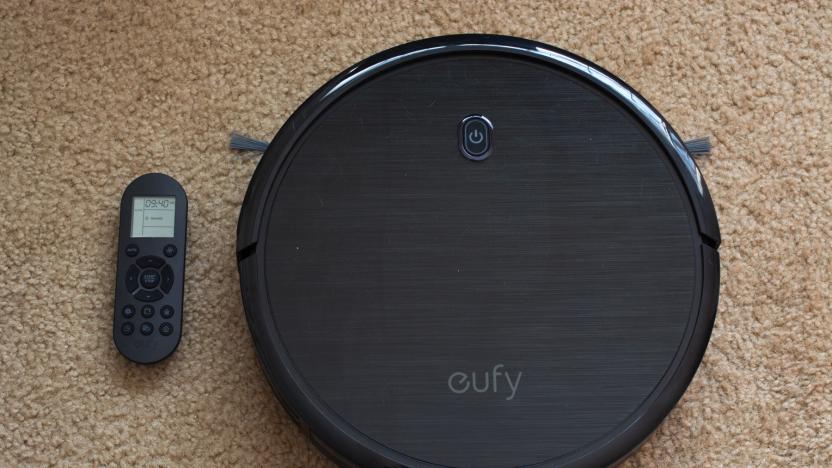
When most kids our age were cutting class to play Mike Tyson's Punch Out, the latch key kids over at Robot Stock News were taking apart their step father's vacuum. And as we grew up, all the while developing relationships with cellphone tipsters and eventually becoming successful tech bloggers in our own right, the Robot Stock News kids were also able to take their obsessive geek tendencies and make a name for themselves -- combing the interwebs, paying off high priced vacuum ninjas, and scouring the US Patent database for any and all news featuring many of our country's leading autonomous vacuum cleaners. They must have been really stoked to stumble upon a patent filed in November 2008, entitled "Compact Autonomous Coverage Robot." As far as we can tell, this document (filed by iRobot) details a Roomba with a squared off front, designed to hit those hard to reach corners that the traditional circular device cannot. This design change, while it seems minor, actually lends a level of complexity to the device: a square robot requires more complex programming, lest it get stuck in a niche that its round faced predecessor could never reach in the first place. Of course, there's no telling when (or if) this one will see the light of day, but you'll know as soon as we do. Promise.

[Via Robot Stock News]

Sony Ericsson's facial recognition patent plays the perfect song to complement your mood

We don't expect this to be indicative of any near-term projects for the now financially hindered phone maker, but one of Sony Ericsson's recently unearthed patents paves the way for some interesting uses. From what we gather, while listening to music on your device, a picture of your face would be taken. That image would then be run through software that interprets your mood, and an appropriate next song based on those emotions would be picked -- so much for the art of mixtapes. Presumably, it'd also require a phone or device with a camera mounted on the same side as the screen, so unless mobile video conferencing takes off in a huge way, we can't see people paying extra for a phone or device with this configuration. And if you just got dumped over SMS, we hope it doesn't intepret those tears as a good time to play that Damien Rice song you two fell in love with. Hit up the read link for the full patent details.

[Via Slash Gear]

Jury awards i4i $200 million in damages in Microsoft patent suit

It's not quite on the level of some of Microsoft's past patent showdowns, but a Texas federal jury found yesterday that the company should pay a still hefty $200 million in damages to Canadian software firm i4i Ltd for some supposed wrong doing. That company had alleged that Microsoft knowingly infringed on one of its patents in both Word and Vista, which apparently concerned "manipulating a document's content and architecture separately." For its part, Microsoft unsurprisingly begs to differ, and says that "the evidence clearly demonstrated that we do not infringe and that the i4i patent is invalid," adding that it will, of course, "ask the court to overturn the verdict."

J Allard's 'Magic Wand' patent application for Microsoft puts Nintendo, sorcerers on notice

It's been awhile since we've heard from J Allard; the man who assumed responsibility for Microsoft's Entertainment and Devices Division (think: Zune and Xbox) in mid 2008 in an effort to unify the experience into a centralized package. Now Microsoft's CTO and CXO (that's, Chief eXperience Office) has co-signed a patent application for a "Magic Wand" first filed in November of 2007 and made public just a few days ago. The patent application reads very much like a Wiimote, hand-held controller,
"The architecture can utilize one or more sensor from a collection of sensors to determine an orientation or gesture in connection with the wand, and can further issue an instruction to update a state of an environmental component based upon the orientation."
It's worth remembering that Microsoft has been rumored to be working on such a controller since at least August 2007. Something they've apparently scrapped for a camera-based solution that will allow gamers to control the action with their bodies and hand-gestures without requiring a hand-held controller -- you know, if current rumors are true. How many days until Microsoft's June 1st E3 press conference again?

[Via TechFlash]

Apple ponders kiosk-style movie and music downloads

This is not the first time we've heard talk of an Apple media download kiosk, nor does it seem any more plausible this time around, but who knows? According to patent docs dredged up by Apple Insider and dating back to the halcyon days of late 2007, the company has certainly put some thought into this, detailing a wireless iTunes station that would allow users to access the iTunes store on the go, using a "virtual physical connection" to the player. As for the kiosk, it would both access media stored locally (perennial faves and new releases) and the rest of the iTunes store over its Internet connection, with users ponying up by either providing their iTunes account credentials or by credit card. Not a bad idea, eh? Well, we won't hold our breath. One more pic for you after the jump, jump, jump...

[Via Apple Insider]

Amazon awarded design patent for Kindle v1, not that anyone would infringe


It's been a few years since the original Kindle was unearthed within the murky blue bowels of the FCC. In that time, Amazon's created a nice little side-business with heaps of critical acclaim. So let's be honest now, there's no point in being nice anymore: the first generation Kindle design was unpleasant, atrocious even, cause for shoegazing Parsons' hipsters with asymmetrical haircuts to bemoan the end of aesthetics while cruelly tracing the Kindle's angular edges across their wrists. Yesterday, Amazon received a US design patent for said Kindle. In a one-line statement, patent D591,741 gives Amazon claim to, "The ornamental design for an electronic media reader, as shown and described." In other words, it says nothing about the underlying technology while giving Amazon, and only Amazon, claim to this particular geometrical configuration for time immemorial. Thank you for that Jeff Bezos.

[Via All Things Digital]

Read -- Patent D591,741
Read -- InformationWeek

Domestic visionary Dyson's totally square kitchen


James Dyson, the man who single-handedly transformed the vacuum cleaner from a symbol of domestic oppression to an object of techno-lust, is back on the scene with not one, but a whole coterie of kitchen appliances designed to save space -- by sticking 'em in a box. No longer must Americans stand for tea kettles shaped like tea kettles, toasters shaped like toasters, or for juicers... you get the idea. What's more, these guys are all designed to work together: controls are uniformly placed on the top or front panels, with devices sharing common power supplies. As it stands, this is all currently little more than a story dreamt up on the basis of a patent, fodder for a slow news day, and something which neither Dyson nor his colleagues commit to actually making a real reality -- even if patent US 2009/0095729 tells us a different story. But what the hell? A guy can dream, right?

[Via Core77]


AOL News

Joystiq

Download Squad

TUAW

BloggingStocks

Asylum

Autoblog

Switched.com

FanHouse

Autoblog Green